2026 Top Medical Crash Cart Types for Global Buyers?
Choosing the right medical crash cart is a practical decision for hospitals, clinics, ambulances, and emergency care centers worldwide. A cart may look like simple mobile storage, yet its design can affect response speed, organization, and patient safety. Buyers must examine drawer layouts, wheel quality, braking systems, sealing options, and compatibility with local emergency equipment.
The 2026 market includes standard adult crash carts, pediatric models, anesthesia carts, isolation carts, and compact emergency carts. Each type serves a different clinical environment. A pediatric cart may require color-coded drawers and weight-based medication references. An anesthesia cart may need organized airway tools, breathing accessories, and secure device compartments. Some facilities prefer stainless steel for demanding cleaning routines, while others choose polymer construction for reduced weight and lower cost.
There is no perfect model.
Global buyers should compare material durability, infection-control requirements, training needs, warranty support, and service availability. Product claims should be checked against recognized quality systems and documented testing, rather than accepted from marketing language alone. Local regulations and hospital protocols also matter, especially when importing medical equipment across regions. A cart with advanced features may still fail if staff cannot identify supplies quickly. That practical weakness is easy to overlook. This guide reviews major medical crash cart types, key purchasing criteria, and realistic selection concerns for international healthcare markets. Manufacturers’ experience matters, but user feedback from daily clinical settings may reveal more.
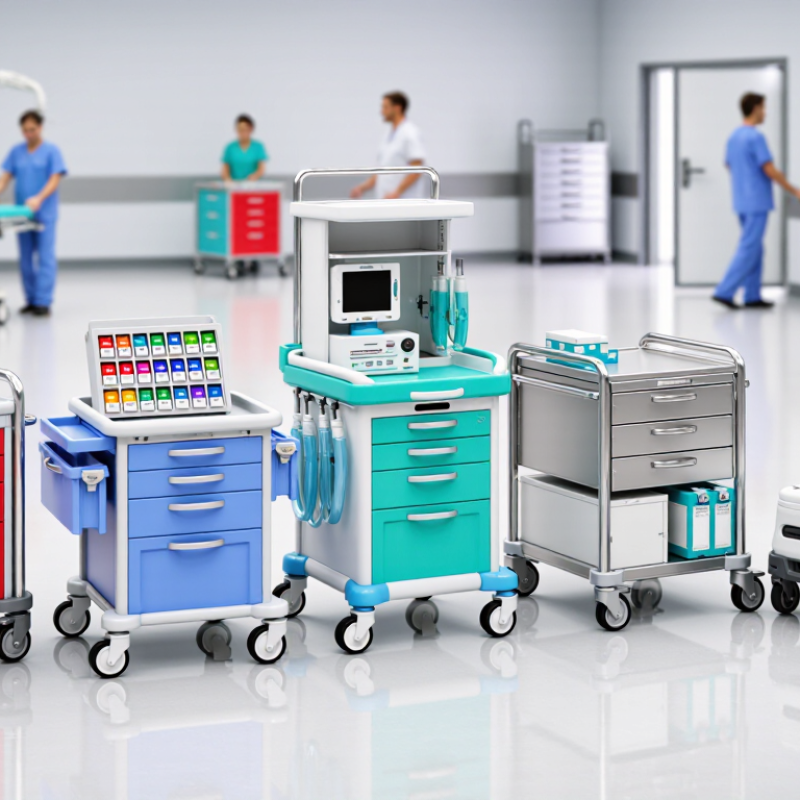
Table of Contents
[Hide]
What Is a Medical Crash Cart and Why Is It Essential?
2026 Top Medical Crash Cart Types for Global Buyers?
What Is a Medical Crash Cart and Why Is It Essential?
A medical crash cart is a mobile, organized unit for urgent patient care. It holds emergency medicines, airway equipment, monitoring tools, and basic resuscitation supplies. Its purpose is simple: bring critical equipment to the bedside without delay. Time matters.
In clinical settings, a well-designed cart supports consistent teamwork during cardiac arrest, respiratory failure, or sudden deterioration. Drawers, labels, seals, and adjustable shelves help staff find items quickly. Adult, pediatric, anesthesia-focused, and compact ward carts serve different needs. Global buyers should match the cart with department size, patient population, power systems, and local clinical protocols.
A cart is only useful when it remains ready. Routine checks should confirm stock levels, expiry dates, battery status, wheel movement, and defibrillator access. Staff training matters as much as construction quality. The difficult truth is that even experienced teams can overlook a missing connector or expired medicine during busy shifts. No cart is perfect. Buyers should request clear documentation, cleaning guidance, maintenance instructions, and compatibility details before purchasing. Local regulations and hospital policies must guide the final configuration, because emergency contents vary between countries and care settings.
2026 Top Medical Crash Cart Types for Global Buyers? - What Is a Medical Crash Cart and Why Is It Essential?
| Crash Cart Type | Primary Clinical Setting | Main Purpose | Typical Equipment and Supplies | Typical Drawer Arrangement | Mobility and Safety Features | Indicative Size Range | Key Buyer Considerations |
|---|---|---|---|---|---|---|---|
| Standard Adult Resuscitation Cart | Emergency departments, intensive care units, medical-surgical wards, outpatient clinics | Rapid response to cardiac arrest, respiratory failure, and other life-threatening emergencies | Defibrillator, adult airway supplies, bag-valve mask, oxygen accessories, suction catheters, IV-access supplies, emergency medicines, gloves, syringes, dressings, and documentation forms | Top surface for monitor-defibrillator; upper drawers for airway and circulation supplies; lower drawers for medicines, fluids, and consumables | Four or five swivel casters, two or more locking casters, push handle, central lock or numbered seal, oxygen-cylinder holder, and CPR board | Approximately 850–1,100 mm high × 650–800 mm wide × 550–700 mm deep | Confirm compatibility with the facility’s defibrillator, electrical supply, medication policy, cleaning agents, and corridor or elevator dimensions |
| Pediatric Resuscitation Cart | Children’s hospitals, pediatric wards, emergency departments, neonatal and pediatric treatment areas | Emergency treatment of infants, children, and adolescents with age- and weight-dependent requirements | Pediatric and infant airway devices, appropriately sized masks and tubes, length-based resuscitation tape or dosing aid, pediatric defibrillation accessories, intraosseous access supplies, and weight-based medication references | Clearly labeled age or weight zones; separate drawers for infant, child, and adolescent supplies; medication-dosing chart kept immediately accessible | Lockable drawers, tamper-evident seal, color-coded labels, oxygen-cylinder support, CPR board, and smooth-rolling casters | Approximately 850–1,100 mm high × 650–800 mm wide × 550–700 mm deep | Prioritize weight-based organization, error-resistant labeling, pediatric power and defibrillator compatibility, and frequent expiry checks |
| Neonatal Resuscitation Cart | Delivery rooms, neonatal intensive care units, maternity units, operating rooms | Immediate stabilization of newborns during birth-related respiratory or circulatory emergencies | Radiant-warming area or warming platform, neonatal masks, ventilation devices, suction equipment, umbilical catheter supplies, pulse oximetry accessories, thermal wraps, cord clamps, and neonatal medications | Dedicated upper work area for newborn care; separate compartments for airway, umbilical access, medications, and thermal-management supplies | Lockable wheels, electrical outlets where required, oxygen and air-gas connections or cylinder holders, storage for a CPR board, and easy-clean surfaces | Approximately 900–1,300 mm high × 700–1,000 mm wide × 600–800 mm deep | Check power requirements, gas connections, warmer performance, infection-control materials, and access around the delivery bed |
| Anesthesia Emergency Cart | Operating rooms, procedure rooms, day-surgery units, anesthesia preparation areas | Management of difficult airway, anesthesia-related complications, malignant hyperthermia, and perioperative emergencies | Difficult-airway devices, video or direct laryngoscopy accessories, supraglottic airways, emergency intubation supplies, capnography accessories, IV equipment, emergency medicines, and specialized procedure kits | Airway equipment in rapid-access drawers; separate sections for vascular access, emergency drugs, difficult-airway devices, and procedure-specific kits | Compact footprint, sealed drawers, anti-static or easy-clean surfaces where required, locking casters, and compatibility with operating-room workflow | Approximately 800–1,100 mm high × 600–750 mm wide × 500–650 mm deep | Evaluate drawer depth for airway devices, local anesthesia protocols, temperature-sensitive drug storage, and operating-room cleaning requirements |
| Cardiac Arrest and Defibrillation Cart | Cardiology units, telemetry wards, emergency departments, intensive care units | Fast deployment of defibrillation, synchronized cardioversion, pacing, and advanced life-support equipment | Defibrillator with adult and pediatric accessories, pacing pads, ECG electrodes, airway supplies, IV and intraosseous access items, emergency medications, and CPR board | Top shelf or platform reserved for the defibrillator; adjacent storage for electrodes, pads, cables, airway items, medicines, and IV supplies | High-load casters, braking system, cable-management features, oxygen-cylinder holder, charging capability, and tamper-evident access control | Approximately 850–1,100 mm high × 650–800 mm wide × 550–700 mm deep | Verify defibrillator shelf load, battery charging, electrical standards, replacement-pad availability, and preventive-maintenance access |
| Isolation and Infection-Control Cart | Isolation rooms, infectious-disease wards, emergency departments, high-risk treatment areas | Provide emergency equipment while reducing unnecessary movement between isolation and clean areas | Selected resuscitation supplies, disposable airway equipment, PPE, waste bags, disinfectant-compatible trays, sharps container, suction accessories, and sealed consumable packs | Separated clean and used-item zones; frequently used PPE and emergency supplies positioned in sealed, clearly labeled compartments | Non-porous surfaces, rounded corners, removable bins, sealed drawers, antimicrobial-compatible construction, locking casters, and easy decontamination | Approximately 800–1,100 mm high × 600–800 mm wide × 550–700 mm deep | Confirm resistance to the facility’s disinfectants, cleaning validation, PPE capacity, waste segregation requirements, and isolation-room clearance |
| Medication and IV Therapy Cart | Wards, infusion centers, emergency treatment areas, long-term care facilities | Organize emergency medicines, routine injectable medicines, fluids, and vascular-access supplies for rapid clinical response | Medication trays, syringes, needles, IV catheters, extension sets, infusion tubing, flushes, dressings, labels, sharps container, and selected emergency drugs | Lockable medication drawers, separate high-alert medication compartment, IV-access drawer, fluid-storage area, and documentation section | Electronic or mechanical locking options, tamper-evident seal, adjustable dividers, smooth casters, and optional waste-disposal holder | Approximately 850–1,100 mm high × 600–800 mm wide × 550–700 mm deep | Address medication security, controlled-drug procedures, cold-chain needs, expiry rotation, drawer weight, and local pharmacy requirements |
| Procedure and Minor Emergency Cart | Outpatient clinics, diagnostic centers, dialysis units, dental and ambulatory-care facilities | Support urgent procedures and initial stabilization where a full hospital crash cart may not be necessary | Basic airway equipment, oxygen accessories, suction items, dressing packs, local emergency medicines, IV supplies, PPE, and sharps container | Compact drawers for airway, circulation, wound care, medicines, and disposable procedure kits | Small footprint, lockable casters, sealable drawers, side rails or accessory hooks, and easy-to-clean worktop | Approximately 750–1,000 mm high × 500–700 mm wide × 450–600 mm deep | Ensure the reduced configuration still meets the site’s emergency-response time, staffing, oxygen, and referral requirements |
Important purchasing note: Crash-cart contents, medication lists, electrical specifications, locking requirements, and dimensions vary by country, facility type, clinical protocol, and applicable medical-device or hospital-equipment regulations. Buyers should validate the final configuration with clinical engineering, pharmacy, infection prevention, and emergency-response personnel.
Related Posts
-

Understanding the Advantages of Lung Exercise Machines for Respiratory Health
-

Top Surgical Equipment Suppliers for Global Buyers
-

7 Best External Catheters Transforming Male Healthcare in 2023
-
How to Choose the Right Patient Bed for Enhanced Comfort and Recovery: Key Insights and Data
-
What Are the Best Hospital Supplies from China?
-
What Are the Top 10 Types of Portable Suction Machines?
