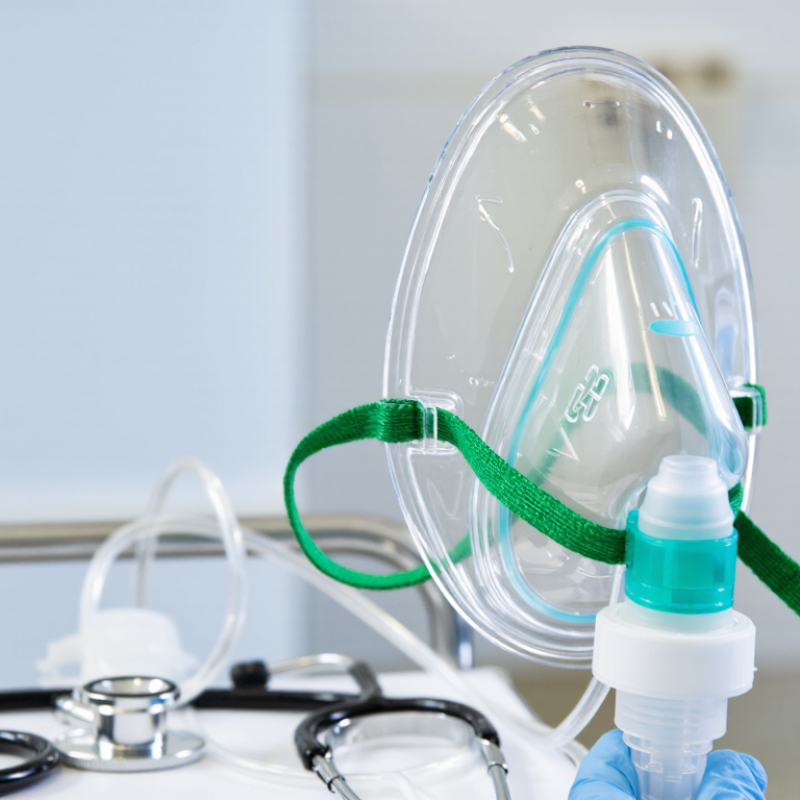
| Primary Purpose | Delivers supplemental oxygen from a central supply system, cylinder, or oxygen concentrator to a patient through the nose and mouth. | Suitable for hospitals, emergency departments, ambulances, home-care programs, and medical relief supplies. | Confirm that the product is intended for oxygen therapy and is supplied with clear instructions for use. |
| Common Mask Types | Simple oxygen mask, non-rebreather mask, nebulizer mask, aerosol mask, and oxygen mask with an adjustable venturi system. | Different care settings require different oxygen-delivery ranges and accessories, so a mixed product portfolio may improve purchasing flexibility. | Check that each type is separately identified and that its compatible tubing, valves, and connectors are specified. |
| Simple Mask Flow Range | Commonly used at approximately 5–10 L/min. Flow below about 5 L/min may increase carbon dioxide rebreathing risk in some designs. | Provides a practical option for routine short-term oxygen therapy when a moderate oxygen concentration is sufficient. | Flow rates should be stated on the instructions and validated according to the product design. |
| Non-Rebreather Flow Range | Commonly used at approximately 10–15 L/min with a reservoir bag and one-way valves. | Useful when a higher oxygen concentration is required before more advanced respiratory support is available. | Verify reservoir inflation, valve function, leak performance, and correct assembly before shipment. |
| Approximate Oxygen Concentration | A simple mask may provide approximately 40–60% oxygen, while a correctly fitted non-rebreather mask may provide approximately 60–90%. Actual values vary with fit, breathing pattern, flow, and equipment. | Helps buyers select the appropriate design without treating oxygen concentration as a fixed guaranteed value. | Product literature should clearly state that delivered concentration is affected by clinical and operating conditions. |
| Typical Facepiece Material | Medical-grade, flexible PVC is widely used; alternative designs may use silicone or other suitable elastomeric materials. | Material selection affects comfort, flexibility, transparency, odor, storage life, and production cost. | Request material specifications, applicable biocompatibility evidence, and declarations for restricted substances. |
| Patient Contact Surface | The cushion is generally shaped to cover the nose and mouth while reducing air leakage and pressure points. | Comfort and fit are important for patient tolerance during extended or repeated use. | Review mask geometry, edge smoothness, flexibility, and sample fit across relevant adult or pediatric sizes. |
| Head Strap | Usually made from elastic textile or soft synthetic material with an adjustable length or quick-release configuration. | Adjustability supports different facial sizes and helps reduce the risk of an unstable mask during treatment. | Check tensile strength, attachment security, elasticity retention, latex status, and ease of adjustment. |
| Oxygen Tubing | Commonly supplied as flexible tubing with standard lengths selected for bedside, transport, or emergency use. | Length and packaging configuration can be adapted to regional purchasing requirements and care environments. | Confirm internal diameter, kink resistance, connector compatibility, gas flow performance, and tube clarity. |
| Reservoir Bag | Used mainly with non-rebreather masks; common nominal capacities are approximately 600–1,000 mL, depending on the design. | Supports higher-concentration oxygen delivery when the bag remains adequately inflated during use. | Inspect welds, film strength, inflation behavior, collapse resistance, and connection security. |
| One-Way Valves | Non-rebreather designs typically include an inlet valve and exhalation valves to limit room-air entry and rebreathing. | Correct valve configuration is essential for the intended oxygen-delivery function. | Perform visual inspection, directional-flow testing, leakage testing, and opening-pressure evaluation where applicable. |
| Connector Compatibility | Oxygen tubing and mask connections commonly use conical medical-gas fittings, with connector dimensions dependent on the applicable design and market. | Compatibility reduces the risk of connection failure when masks are used with different oxygen sources or accessories. | Verify connector dimensions and applicable requirements, including ISO 5356-1 where relevant to the specified connector type. |
| Size Options | Common size categories include adult, pediatric, and infant, although exact sizing systems vary by manufacturer and market. | Offering multiple sizes supports procurement for general hospitals, pediatric services, and emergency-care programs. | Request dimensional drawings, fit guidance, and representative samples for each size. |
| Single-Use Status | Many disposable oxygen masks are labeled for single-patient or single-use applications to reduce contamination risk. | Single-use products simplify logistics in high-turnover clinical settings but require reliable replenishment planning. | Packaging and labeling should clearly state intended use, reuse limitations, and disposal instructions. |
| Sterile or Non-Sterile Supply | Oxygen masks may be supplied non-sterile for routine oxygen therapy or sterile when required by the intended application. | Non-sterile packaging can reduce cost and simplify distribution, while sterile supply may be needed for specific protocols. | Confirm sterilization method, sterility assurance information, packaging integrity, and shelf-life data when sterile supply is specified. |
| Packaging Configuration | Typical options include individual bags, grouped inner packs, and export cartons with product identification and lot information. | Packaging can be adapted for hospital tenders, disaster-response stock, private-label requirements, and warehouse handling. | Check carton dimensions, compression resistance, moisture protection, barcode capability, and traceability information. |
| Labeling Information | Labels should identify the product, size, intended use, lot or batch number, manufacturing date or expiry information where applicable, and storage conditions. | Complete labeling supports customs clearance, clinical use, inventory control, and regulatory review in multiple markets. | Review labeling against the destination market and consider ISO 15223-1 symbols where applicable. |
| Biocompatibility Review | Patient-contacting materials should be evaluated according to the nature and duration of contact. | Documented material safety reduces regulatory and procurement risks during international sourcing. | Request a biocompatibility assessment based on the ISO 10993 series, together with material declarations and test reports. |
| Manufacturing Quality System | A controlled medical-device manufacturing system should cover design, purchasing, production, inspection, complaints, and corrective actions. | A structured quality system improves consistency across production batches and export destinations. | Review the supplier’s current quality certification, audit history, change-control process, and batch traceability; ISO 13485 is widely used for medical-device quality management. |
| Risk Management | Relevant risks may include leakage, incorrect flow direction, material irritation, strap failure, connector disconnection, and inadequate oxygen delivery. | Risk-based sourcing helps buyers compare suppliers beyond unit price alone. | Request a product risk assessment and evidence that key failure modes have been controlled; ISO 14971 is commonly used for medical-device risk management. |
| Storage Conditions | Store in a clean, dry area away from direct sunlight, excessive heat, ozone-generating equipment, and chemicals that may degrade polymeric materials. | Appropriate storage conditions help preserve flexibility, transparency, packaging integrity, and shelf life during global distribution. | Confirm the supplier’s temperature, humidity, stacking, and shelf-life recommendations. |
| Key Pre-Shipment Checks | Visual appearance, dimensional conformity, tubing connection, strap attachment, valve operation, leakage, packaging integrity, and labeling accuracy. | A documented inspection plan reduces the likelihood of receiving nonconforming goods across international shipments. | Use approved samples, defined acceptance criteria, lot sampling, and retained inspection records. |
| Recommended Sourcing Position | Specification-led procurement Select the mask type, size, material, flow range, packaging, and regulatory documentation according to the intended clinical application. | Comparing complete specifications improves transparency, supports multi-market distribution, and reduces dependence on brand recognition. | Approve suppliers only after reviewing samples, technical files, quality documents, production capacity, and destination-market compliance requirements. |