Chat with us, powered by LiveChat

Top Lumbar Traction Table Manufacturers Worldwide

Choosing the right Lumbar Traction Table requires more than comparing prices and product photos. Clinics need equipment that supports controlled spinal traction, safe patient positioning, and consistent daily operation. This guide examines leading manufacturers worldwide through practical and technical criteria. These criteria include design quality, adjustment accuracy, materials, service support, and documented compliance. Details matter.

A reliable manufacturer usually explains how its table manages traction force, pelvic fixation, and patient comfort. Clear specifications help clinicians compare models without relying on vague marketing language. We also consider frame stability, motor performance, emergency release features, and ease of cleaning. In busy rehabilitation rooms, smooth table movement can save valuable treatment time. Installation guidance and staff training also influence long-term outcomes. They are often overlooked.

No ranking is perfect. Manufacturer reputation can vary between regions, distributors, and product generations. A strong brand may still offer a model that does not suit every clinic. Therefore, buyers should verify certifications, warranty terms, replacement-part access, and local technical support before ordering. Independent clinical judgment remains essential. This overview aims to provide a balanced starting point for physiotherapists, rehabilitation centers, hospitals, and professional purchasing teams. It does not replace clinical assessment or equipment testing. A careful comparison should include real operating conditions, such as patient weight limits, room space, transfer needs, and treatment frequency. Practical fit matters.
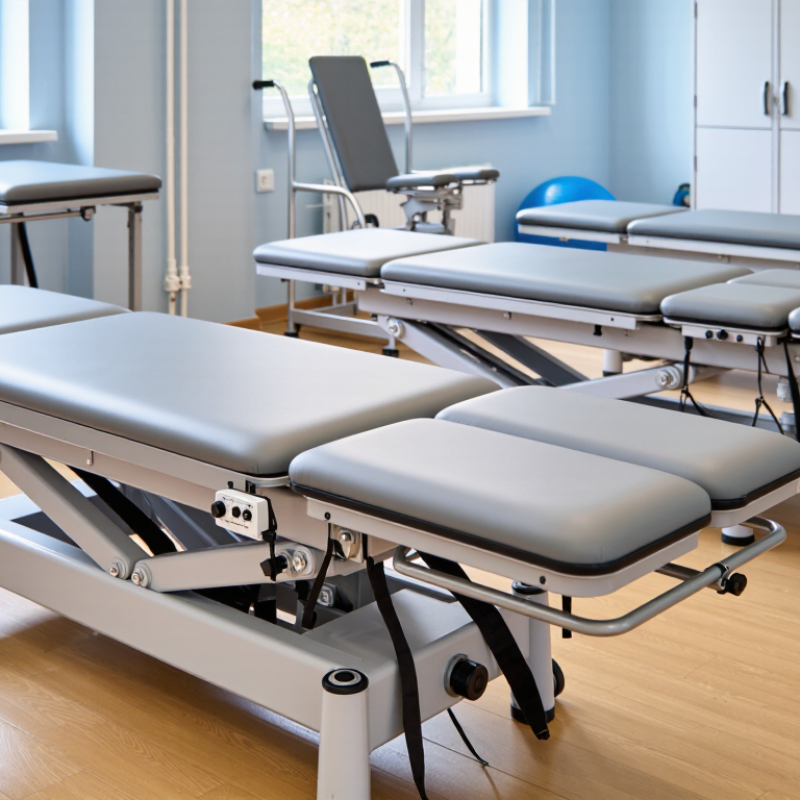
Top Lumbar Traction Table Manufacturers Worldwide

Lumbar Traction Tables: Purpose, Design, and Clinical Applications

Lumbar Traction Tables apply a controlled pulling force along the spine. Their purpose is symptom relief, not mechanical “realignment.” The table usually separates at the waist, while pelvic and thoracic restraints stabilize the patient. Motors regulate force, duration, speed, and release. Emergency controls matter.

The World Health Organization estimated 619 million people experienced low back pain in 2020. It projects 843 million cases by 2050 (WHO, Low Back Pain Fact Sheet, 2023). This growing burden supports careful equipment development. Yet demand alone does not prove clinical value.

Clinical application should begin with a documented assessment and clear treatment goals. Therapists may trial intermittent traction for selected patients with radiating symptoms. The evidence is mixed. NICE guideline NG59 advises against routine traction for low back pain, including sciatica. A Cochrane review also found limited or no meaningful benefit for many patients (2013). That matters. A table cannot replace diagnosis.

For worldwide manufacturers, design quality should include calibrated force measurement, adjustable harnesses, stable positioning, and accessible emergency release. Operators need practical training. ISO 13485-based quality systems can support traceability, risk control, and post-market monitoring. I would not treat a digital display as proof of therapeutic accuracy. Real-world usability matters more. Service records should document calibration, repairs, cleaning procedures, and user feedback. The evidence remains imperfect, and product claims should admit that uncertainty.

How to Evaluate Lumbar Traction Table Manufacturers

Top Lumbar Traction Table Manufacturers Worldwide

How to Evaluate Lumbar Traction Table Manufacturers

Demand deserves careful scrutiny. The World Health Organization reports that 619 million people experienced low back pain in 2020. That figure may reach 843 million by 2050. A large market does not guarantee a safe table.

Evaluate the manufacturer’s evidence, not its promises. Check ISO 13485 certification, risk-management records, and applicable electrical safety testing. Ask for clinical studies describing traction force, treatment duration, patient selection, and adverse events. A brochure showing a relaxed patient is not clinical proof. Request load calibration records and emergency-release testing. The control panel should feel clear through gloved hands, even under pressure.

Look closely at manufacturing experience. Inspect frame joints, belt stitching, motor noise, and the smoothness of table movement. Ask how often components are tested. Confirm service response times, spare-part availability, operator training, and warranty exclusions. WHO guidance also emphasizes exercise and education for low back pain, so traction should not be presented as a universal solution. That matters.

Published data can still be incomplete. Some studies use small samples, short follow-up periods, or inconsistent protocols. I would record those weaknesses rather than hide them. A dependable manufacturer should explain them plainly and provide traceable test documents. Pilot testing with clinicians may reveal practical problems that laboratory reports miss. A quiet motor is useful. Reliable evidence matters more.

Top Lumbar Traction Table Manufacturers Worldwide - How to Evaluate Lumbar Traction Table Manufacturers

Use this weighted evaluation framework to compare lumbar traction table manufacturers objectively. The percentages represent recommended procurement priorities rather than company-specific performance data.

The highest weighting is assigned to regulatory compliance, quality systems, clinical safety, and controllable traction parameters. Buyers should verify certifications, technical specifications, service coverage, warranty terms, and total cost of ownership directly with each manufacturer.

Leading Global Manufacturers and Their Product Strengths

Top Lumbar Traction Table Manufacturers Worldwide

Leading global manufacturers are competing through measurable product strengths, not appearance alone. The World Health Organization reports that low back pain affected about 619 million people in 2020. That figure may reach 843 million by 2050. This pressure encourages manufacturers to improve lumbar traction tables for safer, more consistent clinical use.

Leading suppliers typically offer adjustable pelvic harnesses, controlled traction force, and programmable treatment cycles.

Electric height adjustment also supports better ergonomics for therapists. Some advanced tables combine flexion-distraction movement with traction, helping clinicians adapt treatment to different patient conditions. According to Grand View Research, the global chiropractic care market is expanding steadily, supported by rising musculoskeletal disorders and demand for non-invasive care. However, market growth does not prove that every feature improves outcomes.

Durability remains a practical differentiator. Reinforced steel frames, washable upholstery, quiet motors, and accessible emergency release systems matter during repeated daily use. Manufacturers serving hospitals often emphasize documentation, electrical safety, and calibration support. Smaller clinics may value compact footprints and easier maintenance more than complex software.

The evidence is uneven.

Clinical performance depends on training, patient selection, and correct positioning. A table with higher force capacity is not automatically better. Buyers should review load limits, warranty terms, service coverage, and published testing data.

I would also question impressive touchscreen features when basic pelvic stabilization feels weak.

Product comparisons remain imperfect because manufacturers rarely use identical testing methods. That gap deserves more transparent reporting.

Safety Standards, Certifications, and Quality Control

Top Lumbar Traction Table Manufacturers Worldwide: Safety Standards, Certifications, and Quality Control

Lumbar traction tables must be judged by evidence, not polished brochures. The World Health Organization reports that low back pain affected about 619 million people in 2020. That number may reach 843 million by 2050. Growing demand makes dependable equipment essential. Safety begins with a documented risk assessment under ISO 14971. Manufacturers should also maintain ISO 13485 quality systems for medical-device production.

Check the details closely. The frame should withstand repeated loading without unstable movement. Locking pins need clear engagement indicators. Emergency stop controls should remain reachable during treatment.

Electrical models require testing against IEC 60601-1, including leakage current and mechanical hazards. A valid certificate supports confidence, but it does not replace product-specific testing. That distinction is often missed.

Quality control should cover incoming materials, software, assembly, and final inspection. ISO’s 2023 Survey recorded more than 1.4 million ISO 9001 certificates worldwide, showing the scale of certified quality management. Yet certification alone cannot reveal every weak weld or inconsistent actuator. Independent load testing, calibration records, traceability, and complaint analysis offer stronger evidence.

Ask for test dates, sample sizes, and corrective-action records. Vague answers deserve caution. Even advanced manufacturers can overlook small issues, such as worn upholstery seams or delayed emergency-stop response. Continuous review remains necessary.

Purchasing Factors: Technology, Service, Cost, and Support

Top Lumbar Traction Table Manufacturers Worldwide

A lumbar traction table should be judged by clinical control, not appearance. WHO reported 619 million people lived with low back pain in 2020, with cases projected to reach 843 million by 2050. This growing need makes dependable equipment important. Buyers should inspect traction force accuracy, speed control, pelvic fixation, emergency release, and patient-comfort features. Digital displays help, but they can still drift without calibration.

Technology needs clinical restraint. The WHO 2023 guideline on chronic primary low back pain does not recommend routine traction, so a table should support individualized treatment rather than promise universal results. Look for adjustable programs, documented load limits, and records that help clinicians track outcomes. A short trial with different body sizes can reveal pressure points that brochures hide. Small details matter.

Service often separates a reliable supplier from a cheap purchase. Ask about installation, operator training, spare-part availability, response times, and local maintenance coverage. ISO 13485:2016 emphasizes controlled quality systems for medical-device manufacturers, but certification alone does not guarantee practical support. Request service records and warranty exclusions in writing. Total cost includes downtime, calibration, accessories, and staff training, not only the invoice. I would also budget for unexpected repairs; ignoring them is an easy mistake.

Top Lumbar Traction Table Manufacturers Worldwide - Purchasing Factors: Technology, Service, Cost, and Support

Purchasing Dimension Practical Evaluation Criteria Common Market Benchmark Verification Method Purchasing Importance
Traction Force Range Adjustable lumbar or pelvic traction force suitable for the intended patient population. Many clinical tables provide approximately 20–200 lb (9–91 kg) of adjustable traction force, depending on design. Review the technical datasheet, operating manual, and third-party load-test documentation. High
Control Technology Digital control of force, treatment time, ramp-up, hold, release, and emergency stop functions. Programmable treatment cycles and a handheld or integrated controller are common features on powered systems. Request a live demonstration and confirm that displayed values match measured output. High
Table Configuration Number of sections, motorized movement, pelvic tilt, flexion capability, height adjustment, and patient positioning. Two- to five-section designs are available; powered height adjustment is common on premium clinical models. Compare movement diagrams, maximum angle specifications, and usable treatment-area dimensions. High
Patient Safety Emergency release, mechanical stops, patient restraint compatibility, stable frame, and overload protection. Emergency-stop controls and defined maximum patient weight are expected for powered medical equipment. Check risk-management files, safety-test reports, warning labels, and the stated safe working load. Critical
Electrical Compliance Compatibility with the destination country's voltage, plug configuration, electromagnetic compatibility, and electrical safety requirements. Common supply options include 100–120 V or 220–240 V AC at 50/60 Hz, subject to the configured model. Confirm the product label, declaration of conformity, test reports, and local regulatory requirements before purchase. Critical
Load Capacity Maximum patient weight, frame stability, lifting capacity, and operating load under repeated clinical use. Typical rated patient capacities are approximately 350–600 lb (159–272 kg), varying by model and configuration. Review the safe working load rather than the static frame load and request applicable test evidence. Critical
Materials and Upholstery Frame corrosion resistance, upholstery durability, cleaning compatibility, seam quality, and replacement-part availability. Powder-coated or coated steel frames and medical-grade, fluid-resistant vinyl upholstery are widely used. Request cleaning instructions, upholstery specifications, warranty exclusions, and replacement-cover pricing. Medium
Regulatory Documentation Quality-system evidence, technical file availability, labeling, instructions for use, and market-specific medical-device documentation. Documentation requirements differ by jurisdiction; ISO 13485 certification may support a medical-device quality-management evaluation but does not replace local approval. Validate certificates directly with the issuing body and confirm registration requirements with the importing authority. Critical
Purchase Cost Equipment price, accessories, installation, freight, customs, local taxes, and commissioning expenses. Indicative market pricing commonly ranges from about US$3,000–US$15,000 for powered clinical traction tables, excluding some delivery and regulatory costs. Compare itemized quotations using the same configuration, delivery terms, warranty, and accessory list. High
Total Cost of Ownership Preventive maintenance, calibration, consumables, replacement parts, software, downtime, and service travel. A lower purchase price may result in higher long-term costs if parts, calibration, or local service are difficult to obtain. Request a five-year ownership estimate and a written spare-parts price list. High
Warranty Coverage Coverage period for frame, motors, electronics, upholstery, labor, and shipping of warranty parts. One-year limited warranty coverage is common; longer frame or selected-component coverage may be offered separately. Read the complete warranty terms, exclusions, response obligations, and claim procedure. High
Installation and Training On-site assembly, operator training, preventive-maintenance instruction, and clinical-use guidance. Remote setup support is common for standard shipments; on-site installation may be available at additional cost. Obtain a written delivery-and-training scope, including estimated setup time and staff competency records. Medium
Technical Support Response channels, troubleshooting capability, service hours, remote diagnostics, and escalation process. Email and telephone support are common; response-time commitments vary considerably by supplier and region. Ask for service-level targets, support contact details, escalation contacts, and sample troubleshooting procedures. High
Spare Parts and Serviceability Availability of motors, controllers, cables, restraints, upholstery, fuses, and mechanical components. Suppliers with documented parts catalogs and service manuals generally provide more predictable maintenance planning. Confirm parts lead times, supported service life, local technicians, and whether proprietary components are used. High
Delivery and Logistics Production lead time, packaging, shipping dimensions, delivery terms, installation access, and damage-claim process. Lead times vary by configuration and inventory; custom electrical specifications or accessories may extend production time. Request a confirmed production schedule, packed dimensions, gross weight, Incoterms, and inspection checklist. Medium
Supplier Assessment Manufacturing experience, quality controls, reference installations, complaint handling, and capacity to support the destination market. A documented quality process, traceable production records, and verifiable customer references reduce procurement risk. Conduct a supplier questionnaire, request independent references, and audit documents before placing a large order. Critical

Note: Cost ranges and technical benchmarks are indicative market references only. Final requirements should be confirmed against the exact model, destination-country regulations, intended clinical use, and written supplier documentation.

TOP