How to Choose U 40 Insulin Needles in 2026?
Choosing U 40 Insulin Needles in 2026 begins with one essential check: the insulin concentration must match the syringe. U-40 insulin contains 40 units per milliliter, so a U-40 syringe is calibrated for that concentration. A mismatch can change the delivered dose. Small markings matter.
Dr. Irl Hirsch, an endocrinologist and insulin researcher, has published extensively on insulin treatment and its practical challenges. His work supports a careful principle: match the insulin concentration, syringe, and prescribed dose. This wording is a paraphrase, not a direct quotation. Keep the actual prescription and product labeling close while comparing options; do not rely on needle appearance alone.
Look at the syringe’s U-40 marking, capacity, barrel scale, needle length, and gauge. A clear scale can be easier to read under kitchen lighting, while a shorter needle may feel different during use. Comfort matters, but it does not replace correct calibration. Details can blur.
This guide will help you assess those features, check packaging, and prepare questions for a pharmacist or clinician. Product ranges can vary, and a familiar-looking syringe is not proof of compatibility. If the labeling is unclear, pause and ask a qualified professional to confirm the match before use. That extra check may feel repetitive. It is still worth doing.
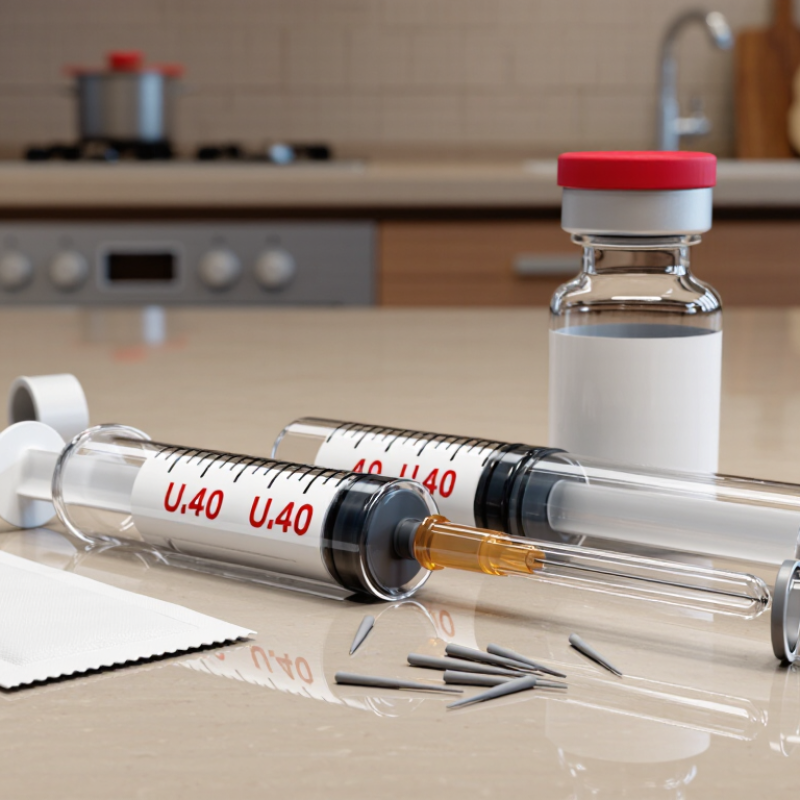
Define U-40 insulin: 40 units/mL and why syringe calibration must match
How to Choose U 40 Insulin Needles in 2026?
U-40 insulin contains 40 units per milliliter (mL). The number describes concentration, not the dose or vial size. A U-40 syringe’s markings are calibrated for that concentration. The barrel matters more than the needle: needles themselves do not measure insulin. Merck Veterinary Manual guidance on insulin administration emphasizes matching syringe calibration to insulin strength. That small label matters.
A U-40 syringe paired with U-100 insulin can deliver more insulin than the markings suggest. The reverse mismatch can deliver too little. Do not estimate a conversion or rely on barrel size alone. Check that both the insulin label and syringe say U-40 before drawing a dose. If either label is unclear, pause and ask a pharmacist or prescribing clinician. A quick visual check is worth the moment.
Medication errors have wider consequences. The World Health Organization’s 2017 Medication Without Harm report estimated their global cost at 42 billion U.S. dollars annually. The CDC’s 2024 National Diabetes Statistics Report estimated 38.4 million people in the United States had diabetes; not all use insulin, but many rely on precise medication routines. I find concentration labels easy to overlook when supplies look similar. Read them under good light, and verify the syringe markings every time.
Compare U-40 syringe capacities: 0.3 mL = 12 units, 0.5 mL = 20, 1 mL = 40
U-40 insulin contains 40 units per milliliter, so syringe capacity sets the maximum dose it can hold. A 0.3 mL syringe holds 12 units; a 0.5 mL syringe holds 20; and a 1 mL syringe holds 40. These figures follow directly from the concentration, not from an estimate. Small barrel, less room. For a prescribed 10-unit dose, all three sizes can hold the amount, but the smaller barrel may make the markings easier to distinguish. The right choice still depends on the prescribed dose and the syringe’s scale.
Check that the syringe is marked U-40 and that its graduations match the intended dose. Do not assume a U-100 syringe gives the same reading; the concentrations differ. ISO 8537:2016 specifies requirements for sterile, single-use insulin syringes, while the Institute for Safe Medication Practices classifies insulin as a high-alert medication. Those references reinforce the importance of using the correct device, but they do not select a size for an individual. I would not choose by capacity alone. If markings are hard to read, or the prescribed dose is close to the syringe’s maximum, ask a pharmacist or clinician to check the match before use. The markings can still be easy to misread.
Check concentration compatibility: U-100 insulin is 2.5 times as concentrated as U-40
When choosing U-40 insulin equipment in 2026, check the concentration printed on both the insulin container and the syringe. U-40 insulin contains 40 units per milliliter; U-100 contains 100 units per milliliter. That makes U-100 2.5 times as concentrated as U-40. The markings are not interchangeable. A syringe calibrated for U-40 measures volume differently from one calibrated for U-100. Read the label carefully, even if the container or syringe looks familiar.
A mismatch can change the dose substantially. For example, drawing U-100 insulin to the “10” line on a U-40 syringe delivers 25 units, not 10. That is a serious dosing error. Pause and check. Use equipment specifically matched to the insulin concentration, and ask a pharmacist or prescribing clinician if the labels do not match or seem unclear. Needle length and gauge affect comfort and injection technique, but they do not correct a concentration mismatch. I know it is easy to focus on the needle in your hand and overlook a small label; that is exactly why checking both labels before each use matters.
How to Choose U 40 Insulin Needles in 2026? - Check concentration compatibility: U-100 insulin is 2.5 times as concentrated as U-40
| Check | U-40 insulin | U-100 insulin | What to do |
| Insulin concentration | 40 units per mL | 100 units per mL | Read the insulin label and match the delivery device to that concentration. |
| Matching syringe scale | Use a syringe specifically marked U-40. | Use a syringe specifically marked U-100. | Do not assume that a syringe marked in units is compatible with every insulin concentration. |
| Volume for 1 prescribed unit | 0.025 mL | 0.01 mL | These volumes differ; use the prescribed insulin with its correctly matched device. |
| Concentration comparison | Reference concentration | 2.5 times the concentration of U-40 | U-100 is more concentrated, so an unmatched syringe can result in a serious dosing error. |
| Needle length and gauge | Length and gauge describe the needle, not the insulin concentration. | Choose the needle or syringe type recommended for the person, injection site, and prescribed device. Confirm the product labeling with a healthcare professional. |
| Before each dose | Check the insulin label, prescribed dose, and device markings. | If the insulin or device has changed, or compatibility is unclear, pause and ask a pharmacist or prescriber before injecting. |
Safety note: Never use a U-40 syringe with U-100 insulin, or a U-100 syringe with U-40 insulin, unless a healthcare professional has explicitly instructed you on a safe, product-specific method. Do not convert doses or transfer insulin between containers on your own.
Choose needle length and gauge for the prescribed injection site and technique
With U-40 insulin, match the delivery device to the insulin concentration. For vial use, choose a U-40-marked syringe, and confirm that its needle is compatible. The needle does not measure the dose; the syringe markings do. Ask a prescriber or pharmacist to check the setup if anything is unclear. Small details matter.
Choose needle length and gauge according to the prescribed injection site and technique. The abdomen, thigh, and other approved sites may require different instructions. Shorter needles are commonly used for subcutaneous injections, but the right choice depends on the person and device. A higher gauge number usually indicates a thinner needle. That may feel gentler, though comfort is not the only factor. Follow the device instructions for insertion angle and any skin-fold guidance. Don’t guess. If injections reach muscle, insulin may be absorbed differently than intended. Rotate sites as directed, and check for bruising, lumps, or irritation. It can feel oddly fussy, but getting the technique reviewed in person is worthwhile.
Verify sterile, single-use packaging and clear U-40 labeling before use
How to Choose U 40 Insulin Needles in 2026?
Verify sterile, single-use packaging and clear U-40 labeling before use.
U-40 refers to insulin concentration and syringe calibration, not needle size. Needle length and gauge are separate details. Check that the package clearly identifies a U-40 insulin syringe and matches the insulin prescribed to you. Easy to miss. U-40 and U-100 products can look similar, but they are not interchangeable without professional guidance.
Inspect the sealed wrapper before opening it. Avoid using a syringe if the seal is broken, the package is wet or punctured, or the expiration date has passed. Look for readable labeling and an intact sterile barrier. Small print can be easy to overlook, especially in dim light; move the package somewhere bright and check it again. If the label is unclear, ask a pharmacist or healthcare professional rather than guessing.
Use each syringe once, then dispose of it in an approved sharps container. Never share a syringe, even if the needle appears clean. A quick check takes only a moment. If you are uncertain whether the syringe matches your insulin, pause and confirm with your care team before using it.
